




Environmental stewardship is a calling from God we embrace.

While our campus is hundreds of years old, our approach to maintaining it isn’t. At St. Thomas’ we implement the most modern and scientific techniques to ensure its beauty and sustainability. It’s why we adopted the Genesis Covenant and reduced our greenhouse gas emissions by 50%. Our Solar Farm reduces our greenhouse gas emissions by 36% and is projected to provide 85% of the electrical needs for the entire campus. We have moved to a compost-recycle-trash approach with the goal of converting food waste and compostable goods into beautiful fertilizer. We also offer 20’ x 20’ garden plots for rent to the community to grow their own food in a safe environment. We invite you to explore it all on our one-mile Harmony Walking Trail.
Caring for God’s Creation
-
The Genesis Covenant was adopted by the Episcopal Church in 2009 and calls on churches to reduce the greenhouse gas emissions from their facilities and operations by 50% within ten years. St. Thomas’ Vestry endorsed The Genesis Covenant in 2019. An inventory of our carbon dioxide and other greenhouse gas emissions was performed in 2021 by Gabel Associates.
St. Thomas’ Solar Farm reduces our greenhouse gas emissions by 36%. Energy conservation/efficiency measures, fuel switching, and other strategies made it possible for us to fulfill our commitment to The Genesis Covenant by 2025, four years earlier than our original goal.
To help churches fulfill their commitments, the Episcopal Church has produced a helpful guide entitled “Getting Started on the Genesis Covenant: Reduce Energy Use, Save Money, and Care for God’s Creation.”
-
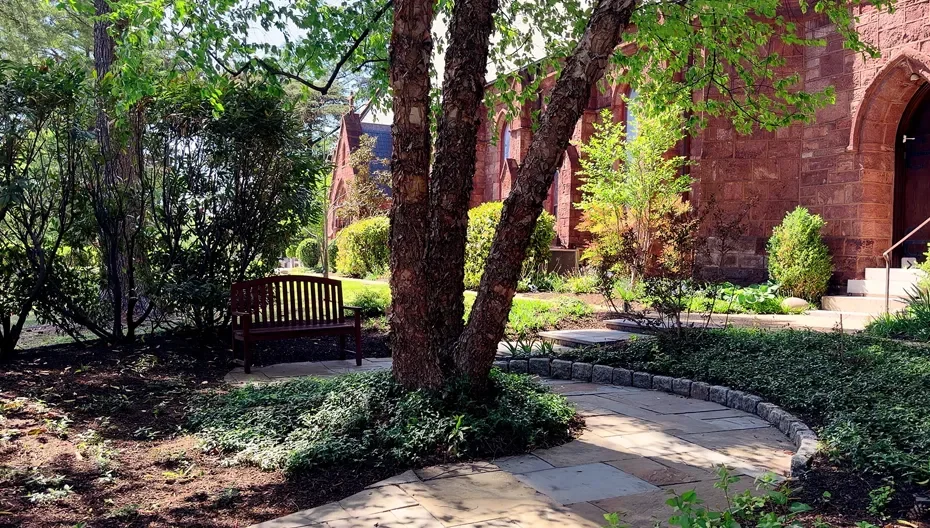
Our property features herbaceous shrubs, gardens, and more than 600 specimen trees representing 84 unique species, of which 46 are identified and tagged for arboretum viewing. The arboretum is open to the public and free of charge. We are guided in the stewardship of our grounds by the words of the prophet Isaiah: “Instead of the thorn shall come up the cypress; instead of the briar shall come up the myrtle; and it shall be to the Lord a memorial.” (Isa. 54:13)
For more information, please visit ArbNet | St Thomas’ Episcopal Church, Whitemarsh
-
St Thomas Church is committed to caring for creation by using compostable food serving supplies across campus, reducing single-use plastics and whenever possible, prioritizing reusable dishware cleaned in energy-efficient dishwashers. Community members are encouraged to bring their own reusable water bottles and mugs to help further reduce single-use waste. Through our partnership with Back to Earth Compost Crew, food scraps and compostable materials are collected and composted locally, helping divert waste from landfills and return valuable nutrients to the soil.
-
St. Thomas’ offers 20’ x 20’ raised-bed garden plots for rent to the community. Please contact Maureen Lucak for more information. Include your email address and phone number to be added to the community garden distribution email.
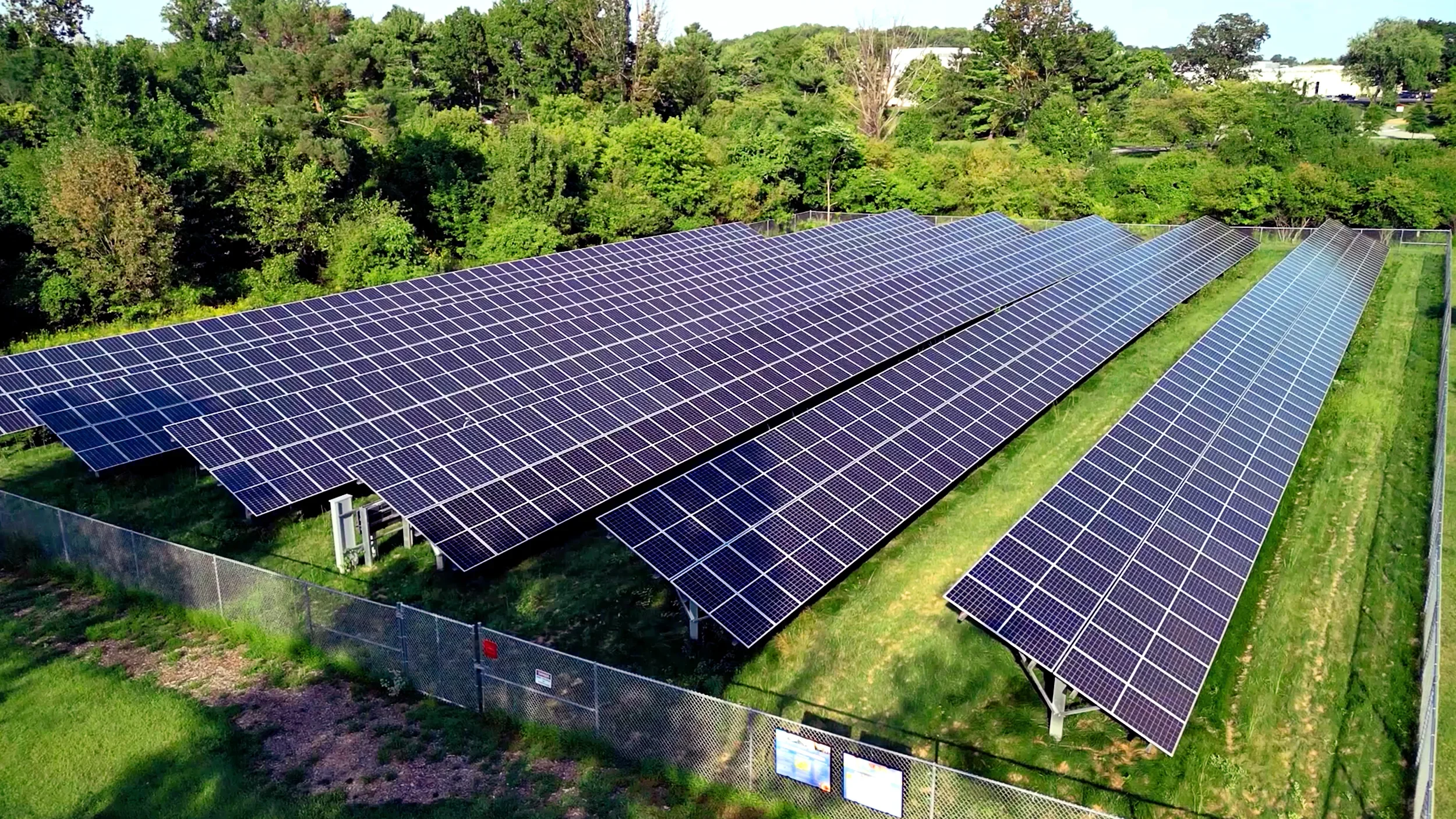
Solar Farm
In response to the Genesis Covenant, St. Thomas’ Church broke ground on a Solar Farm, nestled in the northeast corner of the campus, in the summer of 2020. The solar array is projected to provide 85% of the electrical needs for the entire campus.
Monitoring System Performance
Using data supplied by the two inverters, St. Thomas’ is able to monitor the production of the photovoltaic (PV) system by a web-based dashboard developed by AlsoEnergy. The Dashboard can be accessed from the QR code on the sign mounted on the solar panel fence at the site.
The dashboard displays electricity production over different time periods (from the last three days to the system’s lifetime) and tracks the environmental benefits of the system.
The amount of electricity produced by the PV system correlates with the amount of sunshine hitting the modules, which varies by month and with weather. The expected output of the system is shown on Table 1.
Table 1: Electricity (KWh) generation by month
Learn Net and Virtual Metering
The equipment located between Camp Hill Road and the St. Thomas’ Preschool is where the solar PV system interconnects with PECO’s distribution grid and the PECO account serving the Parish House, the Emily Norris Carey Learning Center, and the St. Thomas’ Preschool. One electric meter measures the electricity generated by the PV system and the other meter measures the electricity usage at these three buildings.
The generation from the solar photovoltaic (PV) system first offsets any usage at these buildings. If the solar generation exceeds the electricity usage, the excess generation goes out to PECO’s local distribution grid, in effect using the distribution system as a “battery.” During periods when the usage at the three buildings exceeds the solar generation (for example, during evenings or overcast days), any solar kWh previously sent to the distribution grid comes back to the buildings at no charge to St. Thomas’ (hence the name “net metering”).
If at the end of the billing month the solar system has generated more electricity than the three buildings have used, the excess is assigned to St. Thomas’ other electric accounts for the remaining buildings on campus through a billing mechanism known as “Virtual Meter Aggregation.” This allows St. Thomas to receive full retail value for all of its solar energy generation. Excess generation is carried forward for up to 12 months and if there is an excess at the end of the year, St. Thomas’ will receive financial compensation from PECO for the excess.
Update on Solar Farm: Our initial five-year contract has ended and we’ll now be able to realize savings of $44,000 a year towards our energy expenses. This is environmentally equivalent to taking 30 cars off the road and planting 2,000 trees and seedlings for ten years.
Our Contributors
We offer special thanks to the Craig family for providing the lead gifts for our solar farm in celebration and memory of Jean L. and Cassin W. Craig.
We also give thanks to all those who have supported our solar project with gifts and panel dedications.
Additional Resources
To learn more, we invite you to view the PDFs below.
“The rhythm of the service, the prayerful pace, the preaching, the walk uphill to the church, the canopy of trees—it all gently peels back the layers of stress.”
—Josh S., a new member of St. Thomas’
Quick links
Campus
History
Give Now